How to Get Better at Sudoku: Strategies from Beginner to Expert
Learn the techniques that turn Sudoku frustration into flow — from scanning and pencil marks to naked pairs, pointing pairs, and X-Wings. A practical guide for every skill level.
Share
Every Sudoku puzzle ever printed has exactly one solution, and you never need to guess to find it. That’s the promise of the game—and the frustration, because when you’re stuck staring at a grid with no obvious next move, it certainly feels like guessing is the only way forward. It never is. What separates a beginner from an expert isn’t intuition or math talent; it’s a toolbox of techniques, applied in the right order. This guide walks through that toolbox, from the fundamentals to the patterns that crack “expert” rated puzzles.
# First, the Rules (30 Seconds)
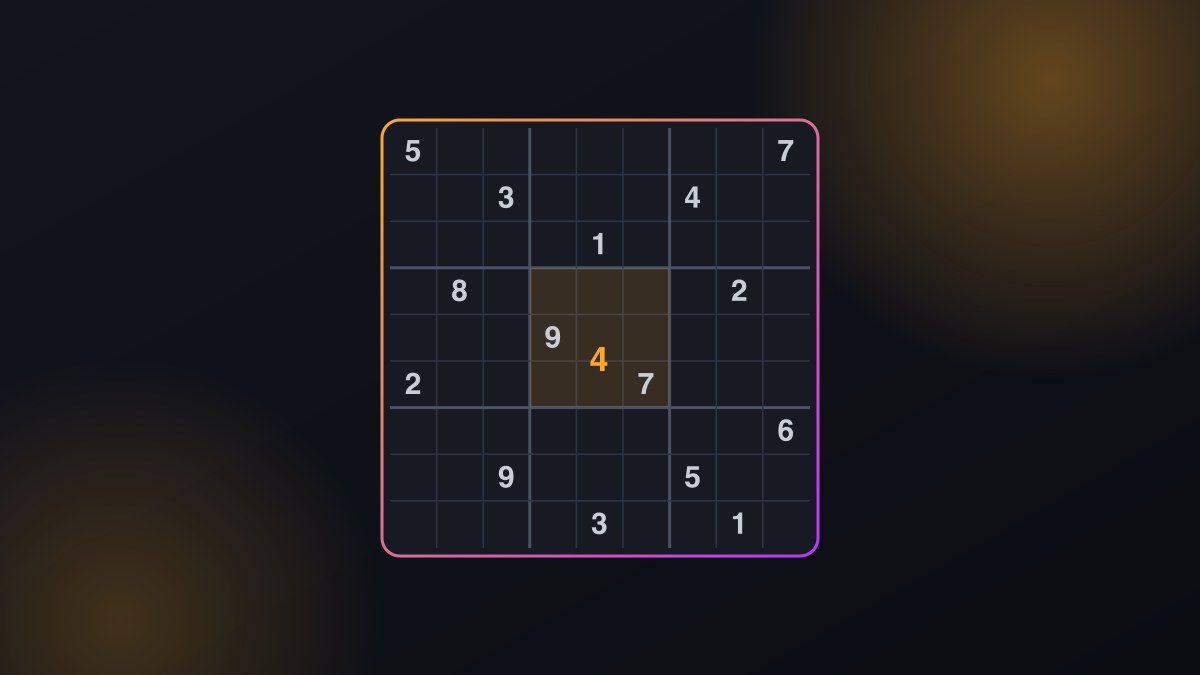
Fill the 9×9 grid so that every row, every column, and every 3×3 box contains the digits 1 through 9 exactly once. That’s it. No arithmetic involved—the digits could just as well be nine different symbols.
# Beginner: Scanning Is Everything
Scanning means picking a digit and checking where it can legally go. Say three of the nine boxes already contain a 7. Those 7s eliminate their entire rows and columns, and often you’ll find a box where only one cell remains legal for a 7. That’s a placement, found in seconds.
Two habits make scanning effective:
- Start with the most frequent digits. If the grid already shows six 5s, hunting the remaining three 5s is usually easy and unlocks other digits.
- Work box by box, not cell by cell. Beginners stare at one empty cell asking “what goes here?” That’s the hard question. The easy question is “where in this box does the 4 go?”
On easy puzzles, scanning alone will carry you to the finish. When it stops producing moves, it’s time for notation.
# Intermediate: Pencil Marks and Singles
Pencil marks (or notes) are small candidate digits written in a cell’s corner, recording what could go there. Every serious player uses them—including champions. They’re not cheating; they’re memory management.
With pencil marks in place, two patterns appear constantly:
- Naked single: a cell with only one candidate left. Fill it in.
- Hidden single: a digit that appears as a candidate in only one cell of a row, column, or box—even if that cell has other candidates. The digit must go there.
Hidden singles are the workhorses of mid-level Sudoku. Train your eye to spot them and “medium” puzzles stop being scary.
A crucial discipline: update your pencil marks after every placement. A stale note is worse than no note—it will eventually mislead you. (Our Sudoku does this automatically if you want it to, but doing it manually is excellent training.)
# Advanced: Eliminating Without Placing
The leap to harder puzzles comes from a mindset shift: powerful techniques don’t tell you what a cell is—they tell you what other cells aren’t. You make progress by deleting candidates.
- Naked pair: two cells in the same row, column, or box that both contain exactly the same two candidates—say {2, 6}. Between them, they will consume the 2 and the 6. Delete both digits from every other cell in that unit.
- Pointing pair: within one box, a digit’s only candidates sit in a single row (or column). Wherever it lands inside the box, that row is used up—so delete the digit’s candidates from that row outside the box.
- Claiming: the mirror image. If a digit’s only candidates in a row all fall inside one box, delete that digit from the rest of the box.
These three techniques, applied patiently, dismantle most “hard” rated puzzles. They feel slower than placing digits, but each elimination tightens the grid, and placements follow in bursts.
# Expert: X-Wings and Beyond
When eliminations dry up, look for structures spanning the whole grid:
- X-Wing: find a digit that, in two different rows, has candidates in exactly the same two columns. Those four cells form a rectangle, and the digit must occupy diagonally opposite corners. Either way, both columns are consumed—so delete that digit’s candidates everywhere else in those two columns.
- Swordfish: the same logic stretched across three rows and three columns. Rarer, but it cracks puzzles that seem impossible.
- XY-Wing: three cells with candidates {A,B}, {B,C}, and {A,C}, where one “pivot” sees both others. Any cell that sees both ends of the wing can’t contain C. This one takes practice to spot, but it’s a genuine “aha” every time.
If a puzzle resists all of the above, resist the urge to guess. Re-scan for hidden singles first—after dozens of eliminations, easy moves often appear where there were none before.
# Habits That Speed Everything Up
- Don’t fixate on one region. Stuck in the top-left box? Leave. The move you need is somewhere else, and it will unlock the region you abandoned.
- Think in threes. Rows and columns pass through boxes in strips of three cells. Noticing which strip a digit must occupy is pointing/claiming logic in disguise, and fast players do it without notation.
- Slow down to speed up. Rushing produces errors, and a single wrong digit can poison twenty minutes of work. Accuracy first; speed follows on its own.
- Finish puzzles you start. The endgame—when the grid is nearly full and singles cascade—is where pattern recognition gets built.
# Does Difficulty Rating Mean More Given Digits?
Not really. Difficulty is determined by which techniques a puzzle requires, not by how many clues it starts with. A 17-clue puzzle (the proven minimum for a unique solution) can be easier than a 26-clue puzzle that demands an X-Wing. So don’t be intimidated by a sparse grid—judge it by how it plays.
# Practice Deliberately
Like any skill, Sudoku improves fastest with feedback. Play just above your comfort level: if easy puzzles feel automatic, move to medium and accept that you’ll be slower for a week. Use hints as a teaching tool—when you’re truly stuck, a good hint shows you the pattern you missed, and you’ll spot it yourself next time.
You can put all of this into practice with Sudoku right here on PSG Online—three difficulty levels, pencil-note support, and hints when you need a nudge. It’s free, runs in your browser, and works on mobile.
And if you enjoy the deductive side of Sudoku, Minefinder scratches a similar itch with a different flavor—every flag you place is a small logical proof. Different grid, same satisfying feeling of certainty.
The grid always tells you the next move. Getting better at Sudoku is simply learning more of its language.
PSG Online
Author