The Psychology of Puzzle Games: Why Our Brains Crave One More Level
Flow states, dopamine, the Zeigarnik effect and the near-miss — the real psychology behind why puzzle games are so satisfying, and why "five more minutes" becomes an hour.
Share
You told yourself one quick puzzle before bed. Forty minutes later you’re still merging tiles, and you’re not even sure you’re having fun exactly—you just can’t stop. What’s going on in your head at that moment is one of the best-studied phenomena in the psychology of play. Puzzle games are small machines built out of cognitive science, and understanding how they work makes them more fascinating, not less. Here’s what’s actually happening.
# The Competence Loop
Psychology’s most durable theory of motivation—self-determination theory—says humans are driven by three basic needs: autonomy, relatedness, and competence. Puzzle games are competence delivery systems. Every solved row, matched pair, or merged tile is unambiguous proof that you got better at a thing, delivered in seconds rather than months.
Real life rarely provides feedback that clean. You can work hard all week and see no visible result. A puzzle grid, by contrast, shows your progress in bright colors and satisfying sounds. That clarity is deeply comforting, and it’s the foundation everything else is built on.
# Dopamine: The Anticipation Chemical
Dopamine is commonly described as the brain’s “reward chemical,” but that’s not quite right. Decades of neuroscience—starting with Wolfram Schultz’s famous experiments in the 1990s—show that dopamine spikes in anticipation of a reward, and spikes hardest when rewards are possible but not guaranteed.
Puzzle games exploit this precisely:
- In a match-3 game, every swap might set off a cascade. Usually it doesn’t. Sometimes it spectacularly does.
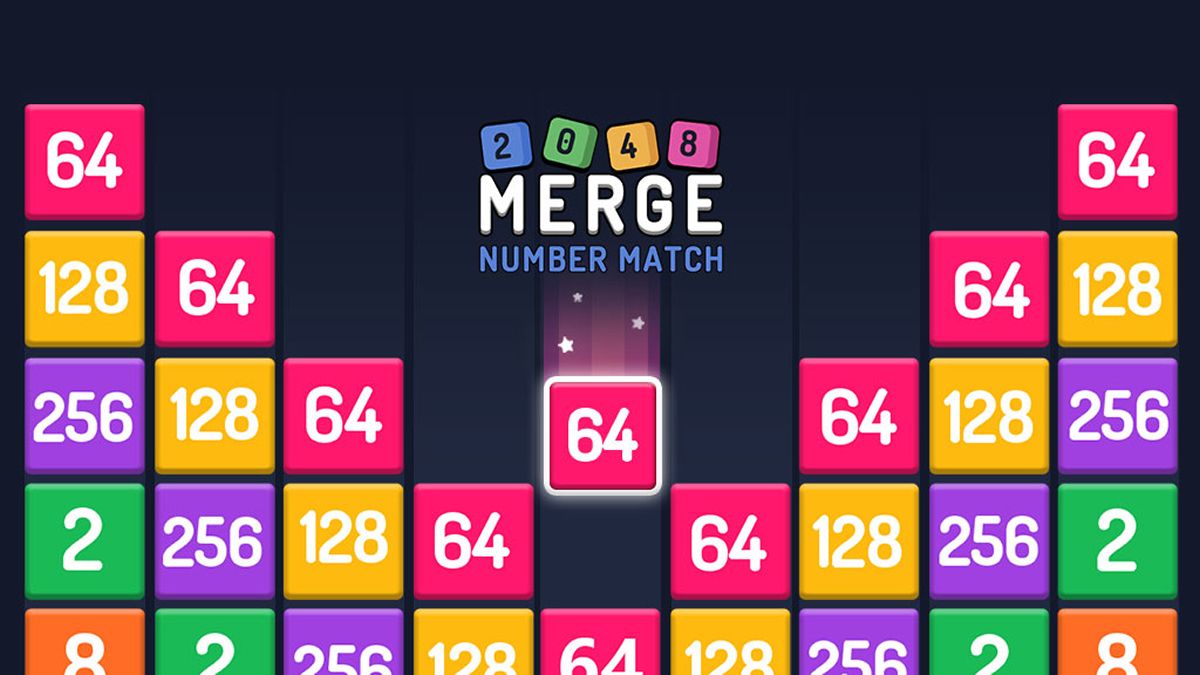
- In Number Merge 2048, every slide might line up a double merge. The big combinations arrive unpredictably.
- In Solitaire, every flip of a face-down card might reveal exactly the card you need.
Predictable rewards get boring fast—the brain habituates. Variable rewards stay interesting almost indefinitely. Puzzle games sit in the sweet spot: skill matters, but chance keeps outcomes uncertain, so the anticipation circuit never fully settles.
# Flow: The Disappearing Clock
Psychologist Mihaly Csikszentmihalyi spent his career studying flow—the state of total absorption where self-consciousness fades and time distorts. His research identified the conditions that produce it: clear goals, immediate feedback, and a challenge balanced right at the edge of your ability.
Read that list again: it’s a description of a well-designed puzzle game. Clear goal (clear the board), instant feedback (points, sounds, animations), calibrated difficulty (levels get harder as you improve). Good puzzle games are flow generators, which is why “five more minutes” so reliably becomes an hour. The clock didn’t speed up; your brain stopped tracking it.
Flow is also why puzzle games are genuinely relaxing for many people. In a flow state there’s no spare attention left for rumination—work stress and anxiety literally don’t fit in working memory. Research on casual games has repeatedly found measurable mood improvement and stress reduction after short sessions.
# The Zeigarnik Effect: Why Unfinished Puzzles Haunt You
In the 1920s, psychologist Bluma Zeigarnik observed that waiters remembered unpaid orders in detail but forgot them the moment the bill was settled. Her follow-up experiments confirmed a broader principle: the mind holds onto incomplete tasks far more tightly than completed ones.
Puzzle games are engineered around incompleteness. There’s always a next level, a nearly finished grid, a high score that’s _just* short of a round number. That open loop nags at you—gently, pleasantly—until you come back and close it. And closing it, of course, opens a new one.
# The Near-Miss: Losing That Feels Like Almost Winning
Here’s the strangest finding in the research: near-misses—outcomes just short of success—activate some of the same reward circuitry as actual wins. A game-over screen with the 1024 tile sitting on the board doesn’t read as failure. It reads as proof you were close, and it produces an immediate urge to try again.
Skill-based puzzle games earn this effect honestly: unlike a slot machine’s manufactured near-misses, your near-miss in Sudoku or Bubble Shooter genuinely reflects your play, and trying again genuinely improves you. The motivation is the same, but here it’s attached to real learning.
# Order From Chaos: The Tidying Instinct
Ask people to describe the feeling of a good puzzle session and one word keeps appearing: satisfying. Cognitive scientists point to the brain’s fundamental drive to detect patterns and reduce disorder—the same instinct behind a freshly organized desk or a perfectly packed suitcase.
Nearly every classic puzzle mechanic is a tidying mechanic. Sorting cards into foundations. Clearing completed rows. Merging duplicates into one. Grouping colors together. Each move converts visible chaos into visible order, and the brain rewards every conversion. Games like Sliding Puzzle and Isometric Sokoban are almost pure distillations of this instinct.
# Is Any of This Bad for You?
The mechanisms above are the same ones that make anything engaging—books, sports, conversation. Puzzle games use them more efficiently, which is why moderation matters, but the research on casual puzzle play is largely positive: mood improvement, stress relief, and modest cognitive engagement, especially for pattern recognition and working memory.
A few honest guidelines from the literature:
- Session endings matter. Stopping at a natural completion point (a solved puzzle, a cleared level) closes the Zeigarnik loop and makes it easier to put down.
- Frustration is a signal. Flow lives at the edge of ability; if a game only annoys you, drop the difficulty—struggle without progress produces none of the benefits.
- Sleep beats streaks. The “one more level” pull is strongest late at night precisely when your prefrontal cortex is most tired. Puzzles will still be there tomorrow.
# Experience It Firsthand
The best way to understand the psychology is to catch it happening. Play a round of Memory Card Game and notice the anticipation spike before you flip the second card. Start Sweet Match 3 and feel the cascade lottery pull you forward. Or open Number Merge 2048 and observe, with scientific detachment, exactly how long “one quick game” lasts.
Your brain evolved to solve problems and celebrate solutions. Puzzle games are simply that ancient machinery, given a playground. Enjoy it—now that you know how the trick works.
PSG Online
Author