The Evolution of Snake Games: From Arcade Cabinets to 3D Worlds
From 1976 arcade origins to Nokia's legendary mobile game and beyond, discover how Snake slithered its way into gaming history and keeps reinventing itself today.
Share
There’s a beautiful irony in Snake: the longer you survive, the harder it gets, because your own success becomes the obstacle. That elegant contradiction has kept players hooked for nearly fifty years, from monochrome arcade screens to the phones in our pockets. Let’s trace the journey of gaming’s most enduring reptile.
# The Arcade Origins (1976–1982)
Snake didn’t start on a Nokia. The concept dates back to Blockade (1976), an arcade game by Gremlin Industries where two players each controlled a growing line, trying to force the opponent into a wall or trail. It was essentially multiplayer Snake before Snake existed.
The idea spawned a wave of clones and variants:
- Worm (1978) on the TRS-80 introduced single-player snake gameplay
- Nibbler (1982, Rock-Ola) became the first arcade game where a player scored over one billion points—Tim McVey played for 44 hours straight to achieve it
- Surround (1977) brought the concept to the Atari 2600
These early versions established the core loop: move, grow, avoid your own trail. Simple, addictive, and infinitely replayable.
# The Nokia Era: Snake Goes Global (1997–2007)
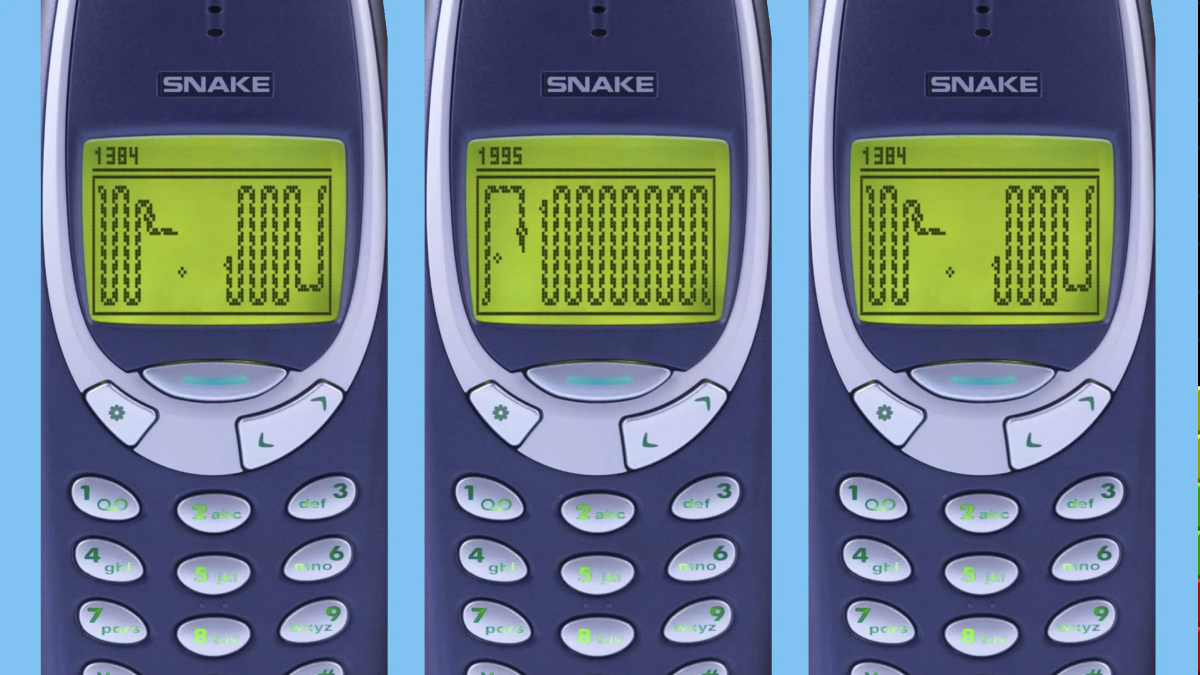
When Taneli Armanto programmed Snake for the Nokia 6110 in 1997, he probably didn’t know he was creating one of the most-played games in history. Pre-installed on over 400 million Nokia devices, Snake became the definitive mobile game long before the App Store existed.
# Why Nokia Snake Was Perfect
- Always available: No cartridge, no download—it was just there on your phone
- Tiny screen, big fun: The 84×48 pixel display of the Nokia 3310 was barely an inch wide, but Snake filled it with tension
- One-handed play: You could play while doing almost anything else
- Universal language: No text, no story, no cultural barriers—anyone could play
Snake II (2000) added wraparound edges and bonus items. Snake III (2003) brought color and maze variants. Snake Xenzia added themes and obstacles. Each iteration expanded the formula while keeping that one-more-try hook intact.
# The Cultural Impact
Nokia Snake was more than a game—it was a shared experience for an entire generation. Before social media, before smartphones, Snake was the thing everyone had in common. High scores were bragged about in school hallways. The game transcended demographics: executives played during meetings, students played during lectures, and everyone played while waiting for the bus.
# The Browser and Flash Era (2005–2015)
As Nokia’s dominance faded, Snake found a new home on the web. Flash game portals hosted hundreds of Snake variants:
- Snake.io and similar games added multiplayer elements
- Slither.io (2016) became a massive hit by combining Snake with competitive multiplayer—grow your worm by consuming glowing orbs and defeated opponents
- Google’s Easter Egg Snake (accessible by searching “snake game”) brought the classic to billions
The browser era proved that Snake didn’t need a specific platform—it could thrive anywhere there was a screen and a way to turn.
# Modern Reinventions (2016–Present)
Today’s Snake games push the concept in directions those 1976 arcade designers never imagined:
# Slither.io and the Multiplayer Revolution
Slither.io (2016) took the internet by storm. Millions of players simultaneously controlled snakes on a shared server, growing by eating pellets and the remains of fallen opponents. At its peak, it was one of the most-visited websites in the world. The genius was in how it handled collision: only your head was vulnerable, so a tiny snake could defeat a massive one through clever maneuvering.
# Snake Goes 3D
Modern takes add full 3D graphics, particle effects, and physics to the classic formula. The flat grid becomes a living arena with lighting, shadows, and visual spectacle—all while preserving the core “grow and don’t hit anything” gameplay that made Snake timeless.
# Competitive Snake
The rise of esports hasn’t skipped Snake. Speedrun communities compete for the fastest times to fill entire boards, while multiplayer variants host tournaments with real prizes.
# Why Snake Still Works
Decades of game design theory have been published since Blockade dropped in 1976, but Snake keeps resonating because it nails fundamental principles:
- Escalating difficulty through success: Your own growth is your enemy—a mechanic that creates natural drama
- Spatial awareness: Constantly planning your path several moves ahead exercises genuine skill
- Instant restart: Death is never frustrating because a new game is one button away
- Visible progress: Your growing snake is a tangible measure of how well you’re doing
- Simple controls: Direction changes are all you need—no buttons, no combos, no tutorials
# Play Snake Today
Ready to experience the thrill of the chase? Snake 3D on PSG Online brings the classic to life with stunning three.js-powered graphics, glowing particle trails, and epic collision effects. Guide your pulsing, color-gradient snake through a 3D arena, eat apples, and try to beat your high score—all free in your browser.
For more arcade action, check out Road Crosser for endless dodging fun or Flappy Wings for another one-more-try classic.
# The Snake Legacy
From a two-player arcade experiment in 1976 to a game played by billions across every platform imaginable, Snake has earned its place in the gaming pantheon. It’s proof that you don’t need a complex story, realistic graphics, or a massive budget to create something timeless. You just need a line that grows, a space that shrinks, and the eternal question: how long can you survive?
The answer, as any Snake player knows, is always “just a little bit longer.”
PSG Online
Author