The History of Minesweeper: The Hidden Game That Conquered the World
How Minesweeper went from a Windows 3.1 time-waster to a competitive sport with world records under 30 seconds. The untold story of gaming's most underrated puzzle.
Share
You’ve almost certainly played Minesweeper. Even if you think you haven’t, you probably clicked around a grid of gray squares on a Windows PC at some point, hit a mine on your third click, and gave up. But behind that deceptively simple grid lies one of gaming’s most fascinating stories—a game that taught millions how to use a mouse, sparked a competitive speedrunning community, and hides legitimate mathematical depth beneath its pixelated surface.
# Before Windows: The Origins (1960s–1989)
Minesweeper didn’t spring fully formed from Microsoft’s offices. Its DNA traces back decades:
1960s–70s: Mainframe games like Cube and Relentless Logic (also called Mines) introduced the concept of deducing hidden information on a grid. Players used logic to identify safe squares—the fundamental Minesweeper mechanic.
1985: Mined-Out by Ian Andrew appeared on the ZX Spectrum, featuring a character walking through a minefield with numbered clues indicating nearby mines. It’s the earliest game that clearly resembles modern Minesweeper.
1989: Robert Donner and Curt Johnson developed Minesweeper for OS/2 while working at Microsoft. Donner later adapted it for Windows.
# Windows 3.1: The Game That Taught You to Click (1992)
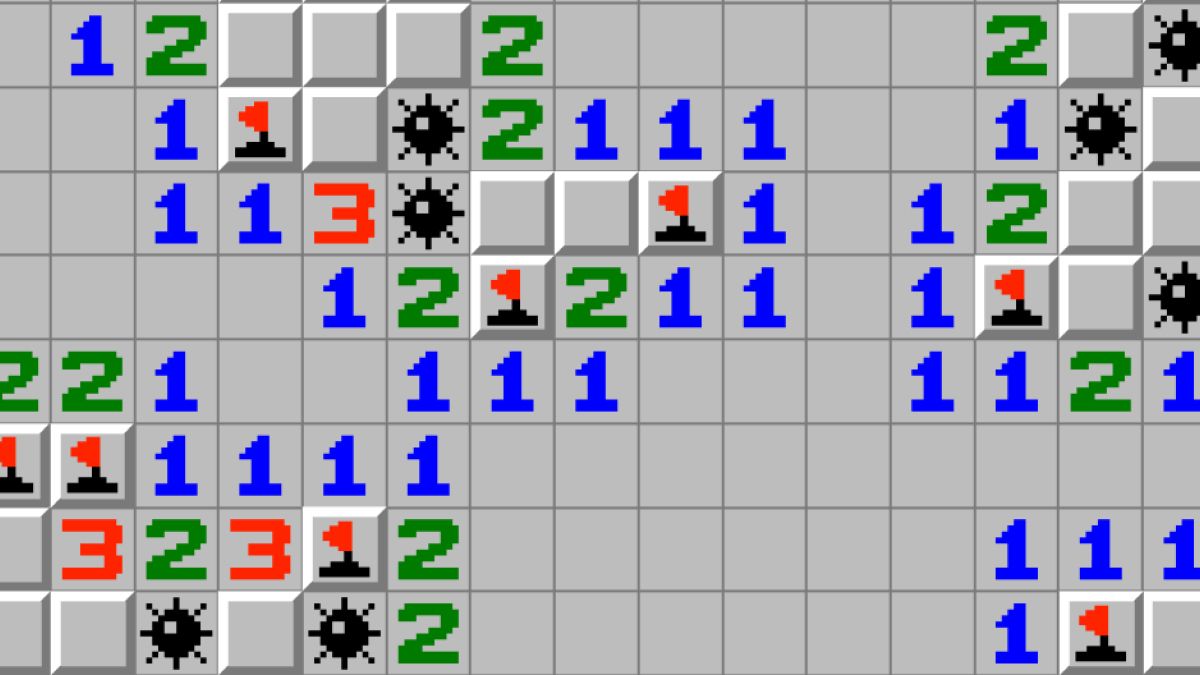
When Microsoft bundled Minesweeper with Windows 3.1 in 1992, it wasn’t just shipping a game—it was shipping a tutorial. The official reason for including Minesweeper (along with Solitaire) was to help users learn mouse skills:
- Left-click: Reveal a square (teaches basic clicking)
- Right-click: Flag a mine (teaches the context menu concept)
- Double-click: Chord—reveal adjacent squares when flags are placed (teaches double-clicking)
This stealth training was brilliant. Millions of office workers who’d never touched a mouse before found themselves right-clicking with confidence after a few lunch-break sessions of Minesweeper.
# The Three Difficulty Levels
Windows Minesweeper offered three classic boards:
| Difficulty | Grid Size | Mines | Mine Density |
|---|---|---|---|
| Beginner | 8×8 | 10 | 15.6% |
| Intermediate | 16×16 | 40 | 15.6% |
| Expert | 30×16 | 99 | 20.6% |
Expert mode—99 mines on a 30×16 grid—became the standard competitive format. That 20.6% mine density hits a sweet spot: hard enough to be challenging, sparse enough to be solvable through logic most of the time.
# The Windows Era: A Desktop Staple (1992–2012)
For twenty years, Minesweeper shipped with every copy of Windows. That’s billions of installations. It appeared in:
- Windows 3.1 (1992): The original, with its iconic flat gray squares
- Windows 95/98/ME: Largely unchanged but universally played
- Windows XP (2001): Gained the classic look most people remember—the sunglasses smiley, the satisfying first-click cascade
- Windows Vista (2006): Visual refresh with a flower-garden theme option
- Windows 7 (2009): Updated graphics, adventure mode, daily challenges
- Windows 8 (2012): Moved to the Windows Store as Microsoft Minesweeper, adding ads and achievements
The Windows 8 transition marked the end of an era. Minesweeper was no longer a built-in freebie—it became a free-to-play app with optional ad removal. Something ineffable was lost.
# The Mathematics of Minesweeper
Minesweeper is more than a casual time-killer—it’s a genuine logic puzzle with deep mathematical properties:
NP-completeness: In 2000, Richard Kaye proved that Minesweeper is NP-complete. This means that determining whether a given Minesweeper position is consistent is as hard as any problem in the NP complexity class—the same category as the traveling salesman problem. Your lunch-break game is computationally equivalent to some of mathematics’ hardest challenges.
Probability and logic: Expert players combine deterministic logic (deducing mine locations from number constraints) with probability calculations when logic alone isn’t sufficient. The best players calculate odds on ambiguous squares in their heads, mid-game.
The guessing problem: Not every Minesweeper board is solvable through pure logic. Some positions require guessing—a 50/50 coin flip between safety and death. The competitive community has debated this for decades, with some variant rulesets guaranteeing solvable boards.
# Competitive Minesweeper: Faster Than You’d Believe
Yes, competitive Minesweeper is a thing, and the times will blow your mind:
# World Record Progression (Expert Mode)
The Expert world record has fallen dramatically over the years:
- 2003: Damien Moore — 38 seconds (seemed impossibly fast at the time)
- 2010: Kamil Muranski — 33.37 seconds
- 2014: Kamil Muranski — 31.13 seconds
- 2024: Records now approach the mid-20s
Players at this level process the grid almost subconsciously, using pattern recognition honed through tens of thousands of games. Their mouse movements are precise to the pixel, and they can identify standard configurations (1-2-1, 1-2-2-1, etc.) instantly.
# The Community
Minesweeper.info serves as the competitive hub, hosting leaderboards and tracking world records. The community has developed:
- 3BV (Bechtel’s Board Benchmark Value): A metric measuring the minimum number of clicks needed to solve a board, used to compare difficulty
- 3BV/s: Clicks per second adjusted for board difficulty—the true measure of skill
- IOE (Index of Efficiency): How close a player’s click count is to the theoretical minimum
# Minesweeper’s Cultural Legacy
Minesweeper has left an outsized mark on culture:
- Office productivity: Alongside Solitaire, it’s responsible for countless lost work hours. Some companies reportedly banned or removed it from corporate Windows installations
- Memes: The “first click mine” experience is universally relatable
- Education: It’s used to teach probability, logic, and constraint satisfaction in computer science courses
- Game design: The “hidden information revealed through logic” mechanic has influenced puzzle game design for decades
# Modern Minesweeper Variants
The classic formula has inspired creative variations:
- Hexcells (2014): Minesweeper on a hexagonal grid with no guessing—pure logic, beautifully designed
- Tametsi (2017): Irregular grids, guaranteed solvable, escalating difficulty
- Minesweeper Genius (2018): Minesweeper meets Sudoku on creative board shapes
- Demoncrawl (2019): Minesweeper as a roguelike RPG—clear boards to progress through dungeons
# Play Minesweeper Today
Ready to test your deduction skills? Mine Finder on PSG Online delivers the classic mine-sweeping experience right in your browser. Flag the mines, clear the board, and chase faster times—no download required.
If you enjoy the logical challenge, you might also love Quiz Game for testing your knowledge or Memory Card Game for another brain-training classic.
# Why Minesweeper Still Matters
In an age of sprawling open worlds and photorealistic graphics, Minesweeper endures because it offers something rare: a pure mental challenge with zero filler. No tutorials, no cutscenes, no microtransactions in its classic form—just you, a grid, and the mines hiding beneath.
Every revealed number is a clue. Every flag is a commitment. Every cascade of empty squares is a rush. And every mine you hit on the very last square? That’s Minesweeper reminding you that logic and luck aren’t always on the same team.
PSG Online
Author