The History of Brick Breaker Games: Paddle, Ball, and Fifty Years of Bricks
From Atari's 1976 arcade experiment to power-ups, lasers, and browser remakes — how the humble brick breaker became one of gaming's most enduring genres.
Share
A paddle, a ball, and a wall of bricks. No genre in gaming asks for less and delivers more. The brick breaker formula has survived for nearly fifty years essentially unchanged, outliving arcade cabinets, home consoles, flip phones, and the Flash era—each time finding a new home on whatever screen people happened to be staring at. Here’s how bouncing a ball at rectangles became one of gaming’s most reliable pleasures.
# 1976: Breakout and the Wall
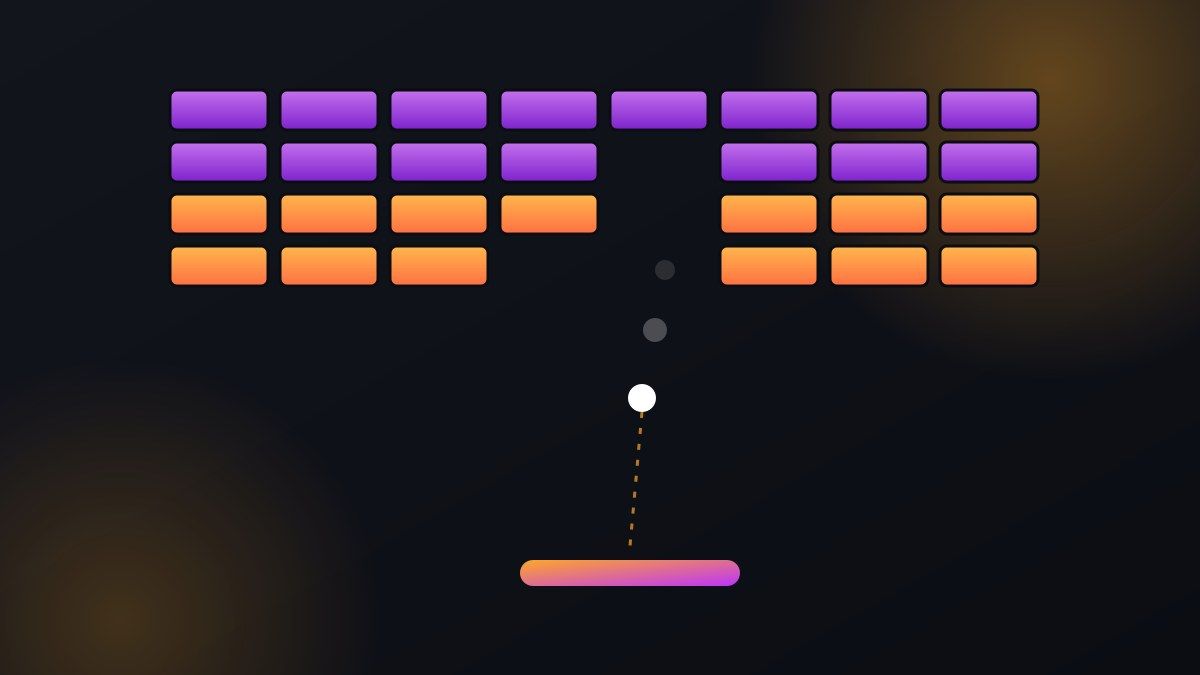
The genre begins at Atari in 1976 with Breakout, conceived by Nolan Bushnell and Steve Bristow as a single-player spin on the company’s massive hit Pong. Instead of a second player, you faced a wall: eight rows of bricks, a bouncing ball, and a paddle you slid along the bottom of the screen.
The development story has become Silicon Valley legend. A young Atari technician named Steve Jobs was tasked with designing a prototype using as few chips as possible—and quietly recruited his friend Steve Wozniak, who engineered a remarkably efficient board in four sleepless days. (Wozniak later learned Jobs had kept most of the bonus money. The two went on to found a small company called Apple anyway.) The final arcade hardware ended up using a different design, but the anecdote sealed the game’s place in tech folklore.
Breakout was a hit, and its DNA spread instantly. The genre it spawned even fed back into history: a young Tomohiro Nishikado cited it as a direct inspiration for the row-clearing structure of his 1978 mega-hit fixed shooter—the game that launched a thousand alien invasions.
# 1986: Arkanoid Perfects the Formula
For a decade, brick breakers were mostly straight Breakout clones. Then Taito’s Arkanoid (1986) arrived and defined what the genre would be forever after. Its innovations are now so standard we forget someone had to invent them:
- Power-up capsules falling from destroyed bricks—expand the paddle, slow the ball, split it into three, add lasers, or grab the ball for aimed shots
- Brick variety: silver bricks needing multiple hits, gold bricks that never break
- Level design as personality: 33 distinct stages with shapes, patterns, and even a boss fight
- A story, thin but memorable: your paddle is a spacecraft, the Vaus, escaping a destroyed mothership
Arkanoid turned a physics toy into a game of risk assessment. Do you chase that laser power-up drifting toward the edge, or keep your paddle safely under the ball? That one decision, repeated hundreds of times, is the genre’s real gameplay.
# The Clone Decades (1990s–2000s)
Brick breakers became the “hello world” of game development—simple enough for one programmer, satisfying enough to actually play. The result was thousands of variants across every platform:
- Alleyway (1989) launched alongside the Game Boy as one of its first titles
- DX-Ball (1996) became a PC shareware phenomenon, its polished feel and generous power-ups making it a fixture of late-90s office computers
- Ricochet series (2000s) pushed 3D visuals and level editors, sustaining a huge community of user-made levels
- Countless Flash versions filled browser portals through the 2000s, keeping the genre a single click away for a generation of students
The genre also cross-pollinated: puzzle hybrids gave bricks hit points and physics, RPG hybrids added loot and upgrades, and mobile developers later fused brick breaking with idle mechanics. The core loop absorbed everything thrown at it.
# Why the Formula Never Dies
Fifty years is a long time for one mechanic to stay fun. The endurance comes from a stack of small, perfectly tuned satisfactions:
- Physical intuition. The ball obeys believable reflection physics. Your brain predicts angles automatically, so every save feels like your skill, and every miss feels fixable.
- Escalating chaos. Multi-ball power-ups and narrow brick gaps create moments where control dissolves into beautiful panic—then the board clears and calm returns.
- The last brick. Every level ends with a mini-drama: one stubborn brick, one precise angle. The genre’s tension curve is built into its structure.
- Visible demolition. Like all great casual mechanics, progress is literal: the wall was there, and now it isn’t. Nothing abstract to track.
It’s the same order-from-chaos loop that powers block puzzles and merge games, but with real-time reflexes layered on top—a bridge between puzzle thinking and arcade action.
# Brick Breaking Today
The genre’s current home is the browser and the phone, where its short sessions and one-hand controls fit perfectly. Modern remakes add particle effects, screen shake, and juicy sound design to the same 1976 loop—proof that great game feel was always the point.
You can play our take right now: Breakout on PSG Online is a free browser brick breaker with crisp physics, power-ups, and progressively trickier walls. No download, no install—just you, the paddle, and the wall.
If you enjoy that blend of reflexes and aim, try Bubble Shooter for the puzzle-flavored cousin of the same idea, or Alien Invasion for pure retro arcade defense with waves that march ever faster.
Half a century on, the wall still stands—and knocking it down still feels exactly as good as it did in 1976.
PSG Online
Author